


#178 Why Motion Sickness Myths Surround 3D Viewing—and How Precision Optics Change the Narrative
Have you ever slipped on a pair of goggles to watch a 3D movie, only to be met with a dull headache or a churning stomach ten minutes later? This experience has spawned a stubborn myth: that all immersive displays inherently cause discomfort. However, as engineers who spend countless hours examining the gap between the human visual system and display hardware, we at GOOVIS know this narrative is based on compromised hardware, not biological inevitability. The relationship between your eyes and a 3D VR headset should be one of cooperation, not conflict. With the right optical architecture, a 3D VR headset can actually reduce the strain you feel compared to staring at a small, flat phone screen.
The Binocular Disconnect: Why Inaccurate 3D Triggers Fatigu
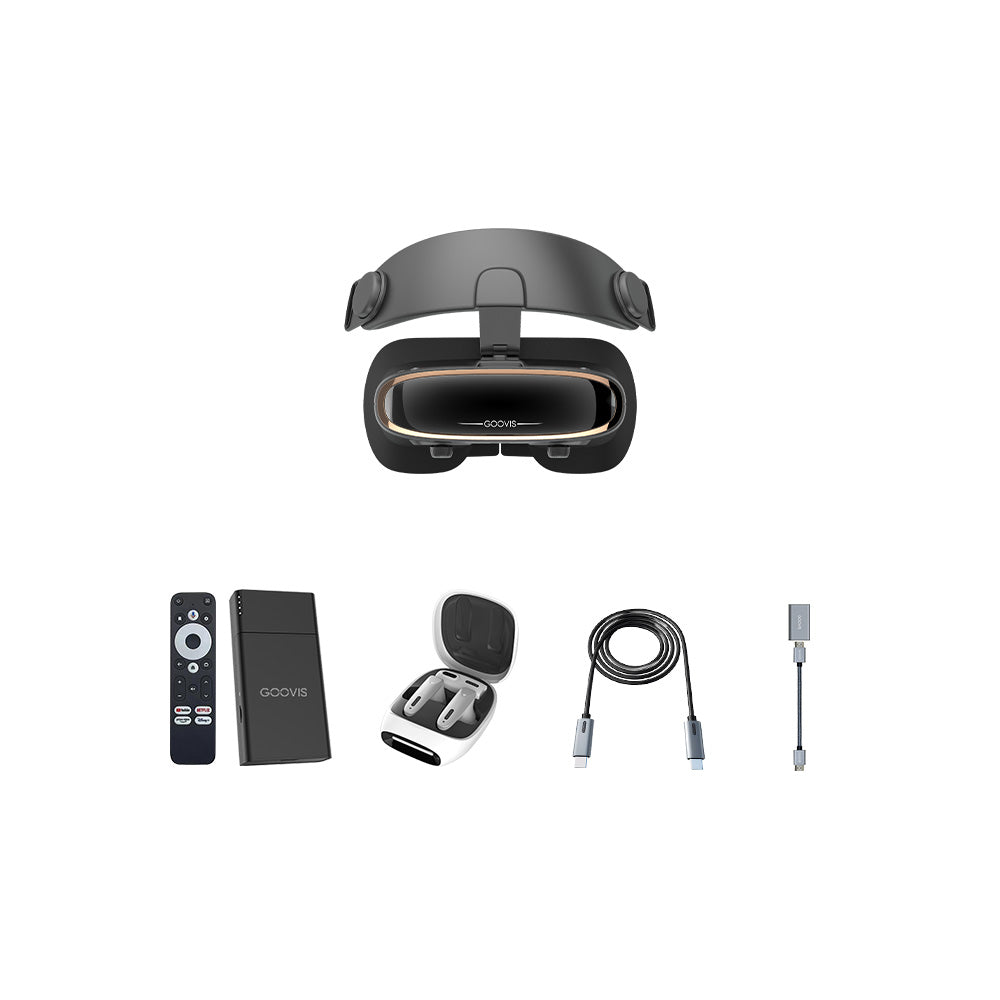
The root of motion sickness in 3D VR headset wear is rarely the 3D effect itself; it is the misalignment of the image with the user's unique physiology. Our brains are wired to fuse two slightly different perspectives from our left and right eyes to perceive depth. When a 3D VR headset lacks precise Pupil Distance (IPD) adjustment, the optical centers of the lenses fail to align with the pupils. The result is the brain working overtime to fix an unfixable geometry, leading to vertigo and nausea. Our GOOVIS G3 Max offers a broad IPD range from 58mm to 74mm, ensuring the visual axis is perfectly matched. Furthermore, for users with myopia or hyperopia, forcing the eye to accommodate through a fixed lens adds another layer of physiological stress. By integrating a wide diopter adjustment of +2.00D to -7.00D directly into the best 3D goggles, we eliminate the need for external glasses that often introduce unwanted distortion and pressure points.
The Perceptual Paradox: Why a Farther Virtual Screen Relaxes the Eye
It seems counterintuitive, but high-quality best 3D goggles often feel more comfortable than watching a television across the room. This is due to the principle of "virtual image distance." When you view content on a standard VR display with simple pancake optics, your ciliary muscles are often locked in a state of constant tension, focusing on a close plane of light. This is the exact opposite of what your eyes need for relaxation. In our G3 Max, the proprietary ASPH (Glass-Plastic Hybrid Aspherical Lens) optical system projects the image to a perceived distance of 20 meters. This simulates a 3D VR headset experience where the eye muscles are in a state of distance vision—essentially at rest. This is a key differentiator for the best 3D goggles on the market. Rather than forcing your vision into an unnatural state, we simulate the effortless way you look at the horizon.
Clarity as a Countermeasure: The Impact of PPD on Brain Processing
A major myth suggests that high-resolution screens are just for aesthetic "wow factor." In reality, clarity is a direct physiological defense against motion sickness. When an image is soft around the edges—a common flaw in lower-tier best 3D goggles due to inferior Birdbath or Pancake optics—your eyes constantly micro-adjust to find focus where none exists. This leads to the "vergence-accommodation conflict" that plagues so many users. Our ASPH optical system in the G3 Max delivers a class-leading 45 PPD (Pixels Per Degree), nearly double the clarity of many high-end best 3D goggles on the market that hover around 20 PPD. When every edge is crisp and free from chromatic aberration or ghosting (thanks to a >100,000:1 contrast ratio and <0.01ms response time of the Micro-OLED panels), your brain stops struggling. It accepts the virtual 1000-inch screen as a stable visual truth, eliminating the subconscious panic that leads to nausea.
Concluding Thoughts on Comfortable Immersio
The connection between a 3D VR headset and comfort is not a myth to be debunked but a standard to be achieved through scientific rigor. While the market floods with devices that sacrifice optical precision for portability, we continue to prioritize the delicate interplay between the human eye and the lens array. The GOOVIS G3 Max is a testament to the fact that the best 3D goggles are not about overwhelming the senses but about delivering information to the retina in the most natural, restful way possible. By respecting the limits of human physiology and pushing the boundaries of aspherical lens design, we ensure that the only thing you lose yourself in is the story on the screen, not a fog of physical discomfort.


